

This weekend I’m off at an undisclosed location filming a dance performance on the beach with Melody Mangler and a bunch of sexy sirens (read about it and the history of mermaids in last week’s post!), so I’m resurrecting one of my favorite pieces from the archives, a list of some of the best articles I’ve ever read.
This is an incomplete list in no particular order, but an excellent place to start if you want to have your mind blown by the human capacity for eloquence in the face of unspeakable injustice, the horrifying destructive power of nature, or the sheer majestic beauty of life in this prime spot of real estate in our solar system.
When the Walls Come Tumbling Down
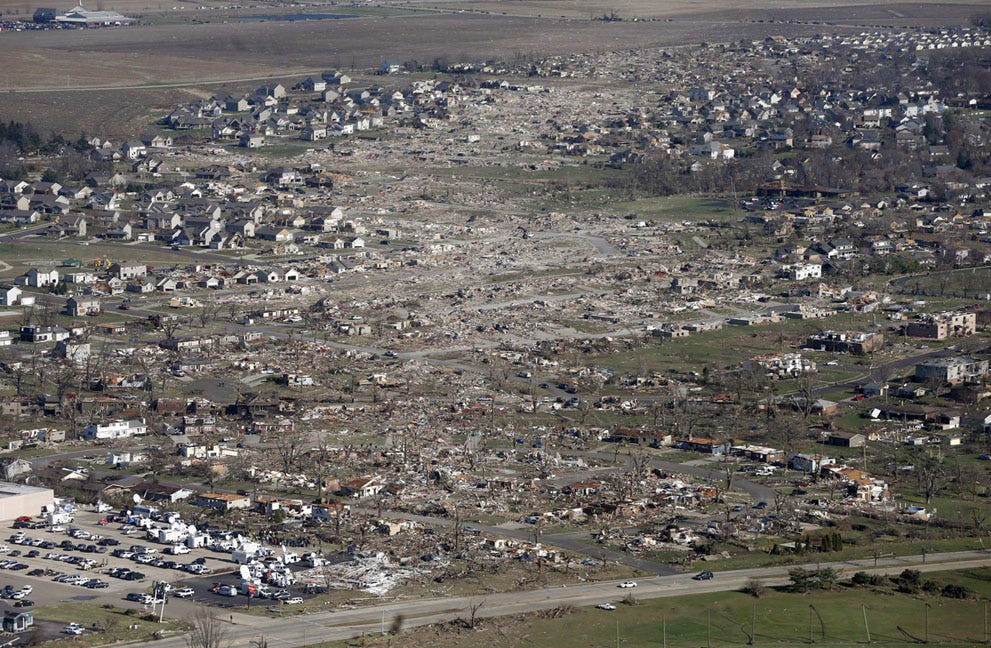
It’s all too easy for us coastal types to survey the latest Midwestern town flattened in Tornado Alley and with all the sympathetic platitudes out of the way, mutter under our breath, “Well, what do you expect when you live in a place nicknamed Tornado Alley?”
We assign their deaths and property damages a place on the sliding scale of tragedy somewhere between bungee jumpers and the Steve Irwins and Roy Horns of the world. After all, there are only so many times the universe will allow you to poke at poisonous snakes with a stick, or pry open the jaws of a full-grown tiger as the audience gasps and squirms in their seats, before the inevitable catches up with you.
Live by the sword/ twister/ scenic yet unstable coastline with the understanding that you may very well die by the sword/ twister/ scenic yet unstable coastline.
But 50 years of predictions, movies, jokes and songs about “the Big One” cleaving Los Angeles away from the continent proper in a great, cataclysmic rip along the well-perforated dotted line of the San Andreas fault hasn’t dimmed the sunny glow of Malibu’s beaches or the seedy glow of Hollywood’s klieg lights.
You don’t see people getting all judgey about the tech moguls who live in flat-out denial just a few miles up the fault line outside San Francisco. And when Hurricane Sandy took down New York City’s power grid in 2013, you didn’t hear the nation collectively shaming its natives for continuing to live in a vertical city built on landfills 100 miles downstream of a nuclear reactor.
You just hear the buzz of the city’s millions of stakeholders working to strengthen their communities, emergency services and redundant supply lines so they’d be better prepared for the next one. (Note from 2026: This last passage hasn’t aged well in Trump 2.0 times, but I left it in for nostalgic value!)
That’s the nice thing about hurricanes, though—they respond reasonably well to human innovation. Seaside resorts where building foundations have been eroding into the sea little by little for decades, their quaintly dilapidated boardwalks crumbling and their sun-bleached midway attractions attracting a few less tourists with each passing year—these are ripe for the pruning when Mother Nature turns on her late-summer pressure washer.
But advances in structural engineering have radically increased the survivability of urban landscapes. Steel-and-glass high rises can take a lot more pummeling by wind and water before their double-paned, double-glazed, impact-resistant windows give way.
Add to that a populace educated in the arts of emergency preparedness, the hyper-vigilant media on the constant lookout for weakness and corruption to expose, and those all-pervasive communication networks we now enjoy—and expect, come hell, high water or a deadly combination thereof. All these have made east coast cities increasingly disaster-proof, capable of weathering anything short of weeks cut off from the power grid.
Earthquakes are another matter entirely.
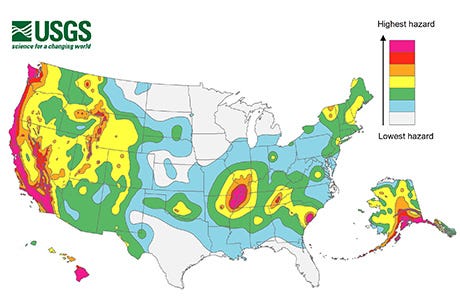
I don’t think I can preface this article any better than ol’ Kottke.org who said: “HOLY GOD, this Kathryn Schulz piece about the already-overdue Pacific Northwest earthquake is terrific and terrifying.” That goes double if you happen to live here.
1. The Really Big One by Kathryn Schulz
Excerpt:
“When the next very big earthquake hits, the northwest edge of the continent, from California to Canada and the continental shelf to the Cascades, will drop by as much as six feet and rebound thirty to a hundred feet to the west—losing, within minutes, all the elevation and compression it has gained over centuries. Some of that shift will take place beneath the ocean, displacing a colossal quantity of seawater...The water will surge upward into a huge hill, then promptly collapse. One side will rush west, toward Japan. The other side will rush east, in a seven-hundred-mile liquid wall that will reach the Northwest coast, on average, fifteen minutes after the earthquake begins.
By the time the shaking has ceased and the tsunami has receded, the region will be unrecognizable. Kenneth Murphy, who directs FEMA’s Region X, the division responsible for Oregon, Washington, Idaho, and Alaska, says, ‘Our operating assumption is that everything west of Interstate 5 will be toast.‘”
Well, shiiiiit. But, you know, I’m actually fine with this plan. If you think all it takes is some apocalyptic prognostication to strike fear into the hearts of everyone in yoga pants country, so that when we look out at the skylines of Vancouver, Seattle, San Francisco and, sure, even that of Los Angeles (such as it is), we’ll see the future shadows of our tombstones... well, you may be right. But on every one of those tombstones we may imagine two words engraved: Fuck Cancer.
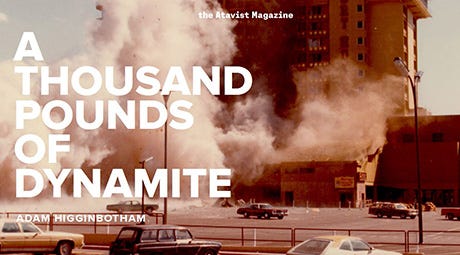
2. A Thousand Pounds of Dynamite by Adam Higginbotham
Excerpt:
By three in the afternoon on Tuesday, the Nevada National Guard was enforcing a quarter-mile cordon around Harvey’s... On the casino floor, the banks of slot machines silently winked their lights. Hands of cards, stacks of chips, and cash lay abandoned on the tables...The bomb team examined the device every way they could. They photographed it and dusted it for fingerprints, X-rayed it and scraped it for paint samples. They scanned it for radiation with a Geiger counter. And, using electronic listening devices and stethoscopes, they strained again and again to hear any sound coming from inside it.
At first the task was almost impossible. The humming of the air-conditioning, the Muzak piped into every room of the building—even the offices—was just too loud... But late that night, it was quiet enough that, for the first time, they were able to pick up something coming from the lower box: an intermittent whirring noise... Somewhere inside the bomb, something was happening.
3. In the Realm of the Unabomber by Gary Greenberg, McSweeney’s Quarterly, 1999 (Read parts I, II, III, VI, XIV at McSweeneys.net.)
Excerpt:
“The first time I got a letter from the Unabomber, I had my wife open it.
I was at work, the letter had come to my house, and neither of us wanted to wait to see what Ted Kaczynski, whose outgoing mail was by then inspected by the United States Bureau of Prisons, had to say.Sealed in a #10 envelope, the letter was addressed in the careful block capitals that the post office says will guarantee maximum efficiency. He even put his return address, in the same frank print, in just the right spot. No fool, Kaczynski knows that the mails will only work for you if you work with them.”
4. Junkspace by Rem Koolhaas, 2001
Excerpt:
“Junkspace is overripe and undernourishing at the same time, a colossal security blanket that covers the earth in a stranglehold of seduction... Junkspace is like being condemned to a perpetual Jacuzzi with millions of your best friends... A fuzzy empire of blur, it fuses high and low, public and private, straight and bent, bloated and starved to offer a seamless patchwork of the permanently disjointed. Seemingly an apotheosis, spatially grandiose, the effect of its richness is a terminal hollowness, a vicious parody of ambition that systematically erodes the credibility of building, possibly forever...”
5. The Simpsons Generation by Chris Turner, Shift Magazine, 2002 (Sadly, not available online, but he did expand the celebrated article into a book, available here.)
Excerpt:
“We will never know just how great an opportunity was lost, how much passionate momentum squandered. Here were the people of virtually the entire world—and certainly the entire First World—rising as one, ready to sacrifice, wanting to help. Who knows how many oversights could have been corrected, inequalities eliminated, hypocrisies inverted?
Who knows what glorious civilization could have emerged from the ashes of those towers? One thing is for certain: Our leaders didn’t, and don’t. They have failed us completely in this regard—particularly those of the United States of America, that self-proclaimed last best hope for humanity. America’s primacy of place and supremacy of power in world affairs, be they economic, political, military or cultural, has never been more apparent than in the wake of September 11, when, as if in some half-witted Hollywood movie, the whole world looked to America for direction. And was told to go shopping.”
6. Ah, Wilderness! by Art Linson, Vanity Fair, April 2002
This is the hilarious behind the scenes story of the making of the movie, “The Edge” with Anthony Hopkins and Alec Baldwin. For anyone who loves podcasts like “How Did This Get Made” or “What Went Wrong,” this is like the pre-podcast version of that, only way less polite.
Excerpt:
“First, we received the obligatory and expected turndown from Harrison Ford. At that time, any script that required a male lead over 45 went directly to Harrison... It didn’t matter if the character was an international spy or a transvestite... Unless, of course, Tom Cruise was interested. Cruise would’ve been allowed to play the bear in our script, or any other role of his choosing...
If several actors or directors pass, their enthusiasm goes on life support... and eventually, as the rejections add up, finger-pointing inevitably follows. “Who the fuck on my staff liked this piece-of-shit script anyhow?” “Can you believe even Richard Gere thought it was bad?”
7. The Acid King by Peter Wilkinson (Rolling Stone, July 5, 2001)
Excerpt:
“In some ways, the story of Leonard Pickard and Todd Skinner is a story about the collision of Sixties idealism with the materialism and pragmatism of the nineties—Timothy Leary’s America versus Bill Clinton’s, if you will. And its moral will be clear even before the Judge calls the court to order; the sweet but easily corruptible dream of the flower-power generation never really stood a chance—but it was fun while it lasted.”
8. The Lilly Suicides by Richard DeGrandpre, 1999
Excerpt:
“The rate of depression in the 1950s was estimated at about 50 people per million, an estimate that would grow to 100,000 per million by the end of the century. This is a 2,000-fold increase in what is ostensibly a hereditary disease. What happened during these years is not that a disease was discovered, or its cure. What happened is that, because of ongoing changes in the drug marketplace, the pharmaceutical industry began to take an interest in depression.”
9. An Open Letter to My Sister, Miss Angela Davis by James Baldwin, November 19, 1970
Excerpt:
“Dear Sister:
One might have hoped that, by this hour, the very sight of chains on black flesh, or the very sight of chains, would be so intolerable a sight for the American people, and so unbearable a memory, that they would themselves spontaneously rise up and strike off the manacles.But, no, they appear to glory in their chains; now, more than ever, they appear to measure their safety in chains and corpses. And so, Newsweek, civilized defender of the indefensible, attempts to drown you in a sea of crocodile tears (’it remained to be seen what sort of personal liberation she had achieved’) and puts you on its cover, chained...”
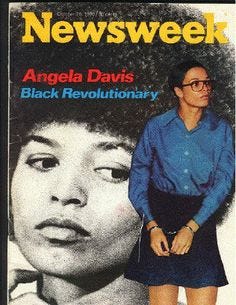
Beautifully poignant and brutally candid, this letter sums up much of what was and still is, 44 years later (Note from 2026: Make that 56 years later), tragically wrong with race relations in America. It’s also an interesting counterpoint to an essay published earlier the same year, Radical Chic and Leonard Bernstein’s Party for the Black Panthers.
Unfortunately, despite the zesty retro bite of passages like the one below, Tom Wolfe’s article reads to the modern mind like a whiter shade of Lenny Bruce’s How To Relax Your Colored Friends at Parties.
Excerpt from Radical Chic by Tom Wolfe, Jun 8, 1970:
“Christ, if the Panthers don’t know how to get it all together, as they say, the tight pants, the tight black turtlenecks, the leather coats, Cuban shades, Afros. But real Afros, not the ones that have been shaped and trimmed like a topiary hedge and sprayed until they have a sheen like acrylic wall-to-wall—but like funky, natural, scraggly. . . wild . . .These are no civil-rights Negroes wearing gray suits three sizes too big—
—no more interminable Urban League banquets in hotel ballrooms where they try to alternate the blacks and whites around the tables as if they were stringing Arapaho beads——these are real men! Shootouts, revolutions, pictures in Life magazine of policemen grabbing Black Panthers like they were Viet Cong—somehow it all runs together in the head with the whole thing of how beautiful they are. Sharp as a blade.
The Panther women—there are three or four of them on hand, wives of the Panther 21 defendants, and they are so lean, so lithe, as they say, with tight pants and Yoruba-style headdresses, almost like turbans, as if they’d stepped out of the pages of Vogue, although no doubt Vogue got it from them.”
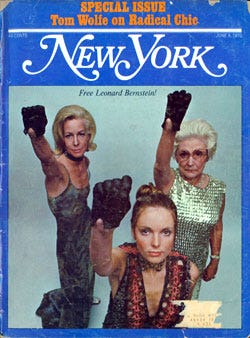
While we’re on the topic, here’s another relevant tidbit from Jet magazine, 1970:

10. Total Eclipse by Annie Dillard
I honestly think this might be the best article I’ve ever read.
Excerpt:
“This was the universe about which we have read so much and never before felt: the universe as a clockwork of loose spheres flung at stupefying, unauthorized speeds. How could anything moving so fast not crash, not veer from its orbit amok like a car out of control on a turn?”
Bonus article, and a bonus list!
11. The Theory of Receptivity and Some Thoughts on Ethan Hawke’s Face by Michelle Orange
The first half of this essay is a somewhat self-indulgent (but braver than I was in my mid-40s) meditation on aging. The second half is a righteous nomination of 1999 as one of the best years ever in film, with which I couldn’t agree more (and which I also noted in my 2009 year in review). Note from 2026: I think it’s widely agreed now that 1999 was in fact the high-water mark of film, full stop.
Excerpt:
“The fall is where things really get ridiculous: next is the one-two crunch of Boys Don’t Cry and Fight Club, both of which had me wandering out into the streets with the anguished, bleary look of someone who’s been kidnapped, injected with adrenaline, alienation, and heartbreak, and kicked out of a moving car.”My List within a List: The 26 Best Films of the Best Year in Film within My Lifetime (1999)