

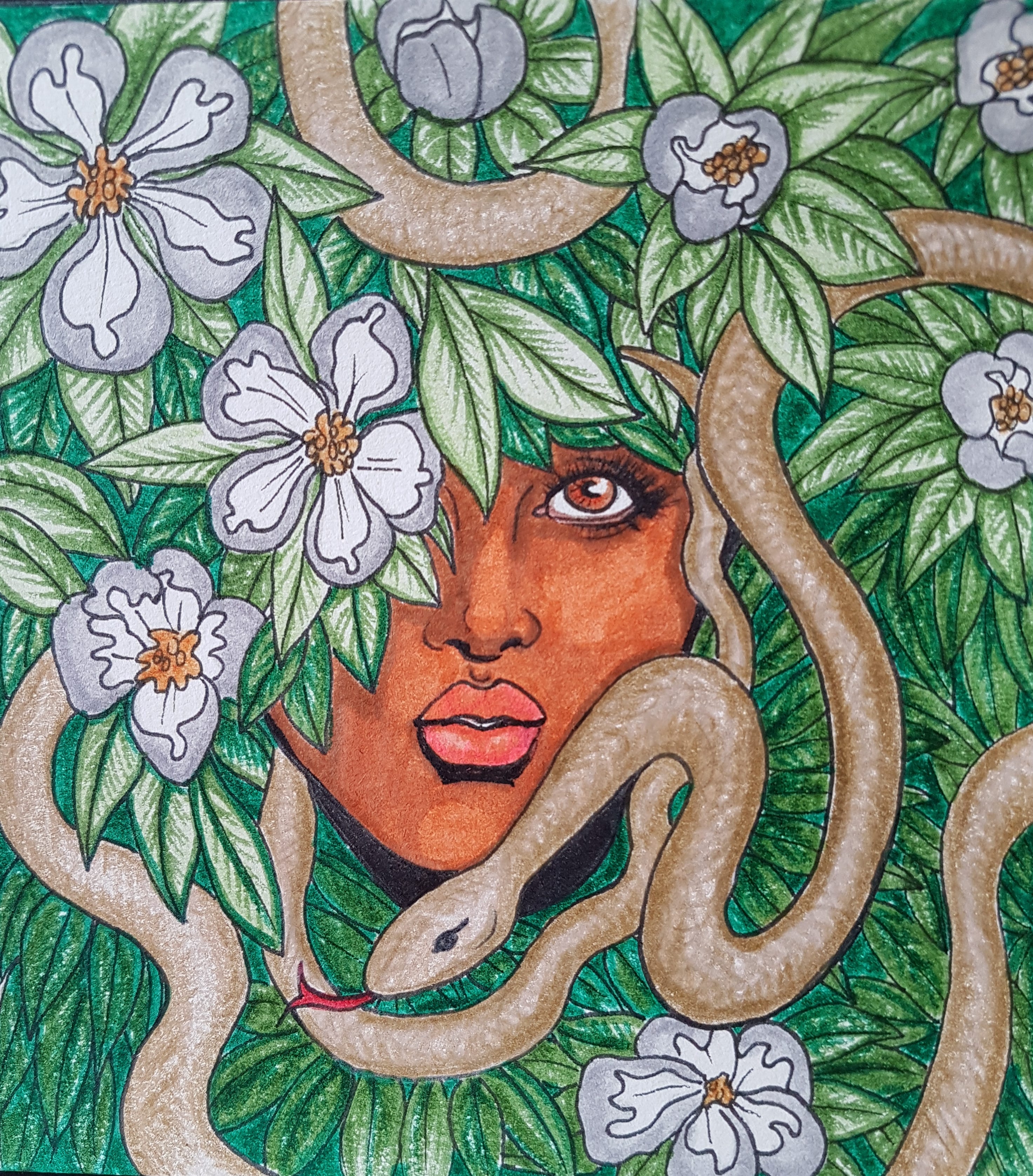
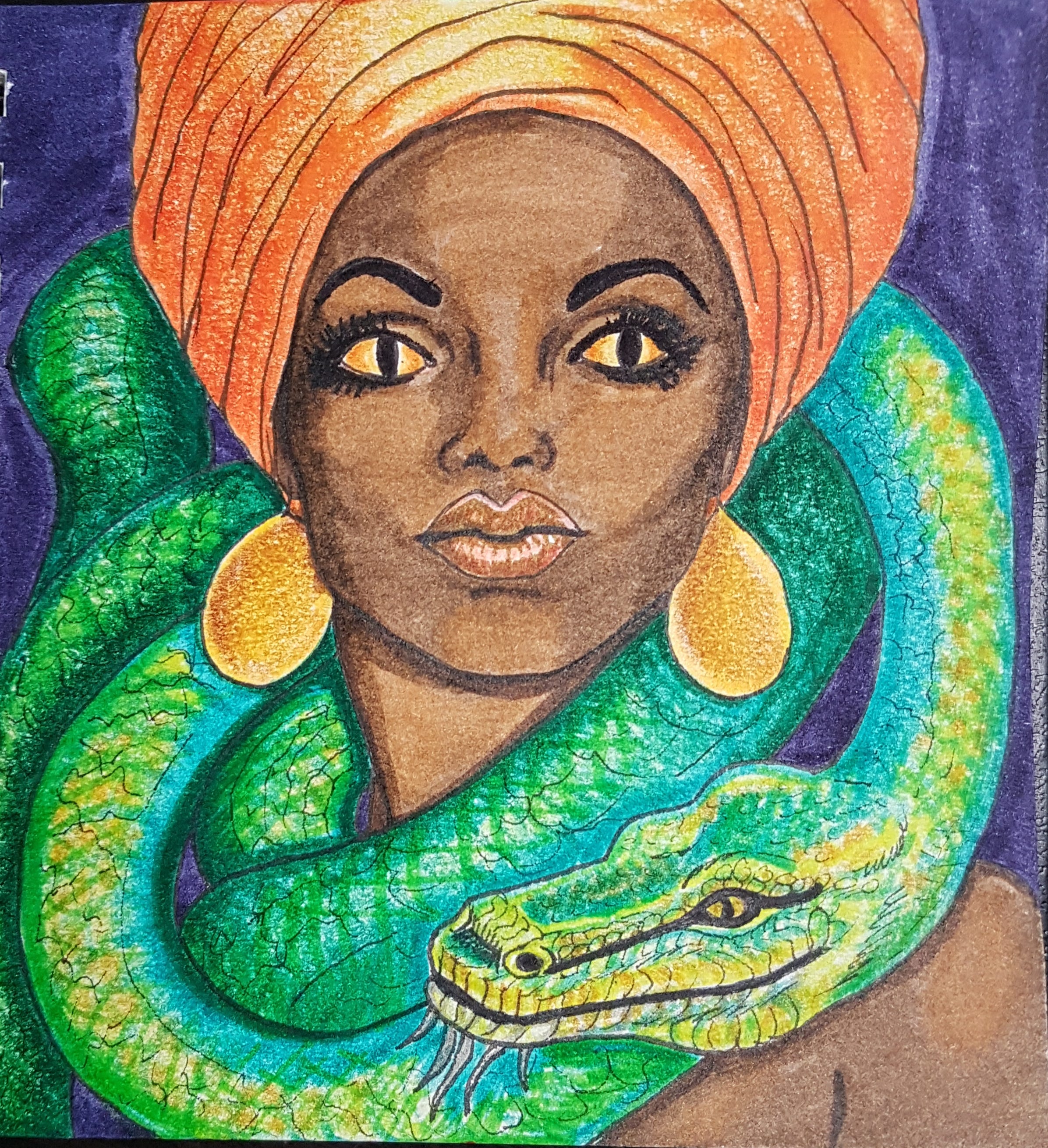
Mami Wata (literally “Mother Water”) is an African goddess of fresh water, often depicted as a mermaid or snake charmer. She’s revered in Central, West, and Southern Africa as a symbol of fertility, abundance, health, and wealth.
Mami Wata represents the dual nature of water, without which life as we know it would not exist, but water in excess or in the form of a hurricane, storm surge, or flood, is among the most destructive forces on earth.
Earth and Water
In astrology, earth and water are the feminine elements, while air and fire are masculine. Earth gives life and shape to matter; it is stable and supportive, giving form to living structures and nurturing all the flora and fauna that rely on it for sustenence.
Earth in the form of soil produces plant life, the basis of the entire food chain, while earth in the form of mountains seems unyielding and eternal until the primal forces beneath it cause it to shake, erupt, and explode in catastrophic violence.
Water takes the shape of whatever vessel holds it. Without the molecules that form water in our atmosphere, no life would exist on our planet. It would be a barren, wind-swept wasteland like Mars. Even the most seemingly passive bodies of water contain the building blocks of life and, at the molecular level, water is constantly in motion.
Water covers over 70% of the globe, from the vast oceans to the mighty rivers, to the millions of lakes and streams, and all that water is connected through the rain cycle that replenishes and distributes it like the lifeblood of a living organism.
Take away our salt-laden oceans, which make up 97.5% of the water on earth, and only 2.5% of the water supply consists of fresh water. A further 68% of that exists as glacial ice at the planet’s poles.
Water is Life
Understanding this, we begin to see what the ancients instinctively grasped, that fresh water is the single most important element to our survival.
Human beings can only survive for a few days without water. Depending on environmental conditions, general health, and other factors, a week to 10 days seems to be the maximum.
There are of course outliers and anecdotal accounts of people surviving several weeks without water, but that is highly unusual. Our bodies are made up of around 70-75% water, so the longer we go without it, the faster our organs and living systems break down.
But since the dawn of recorded history, mass death has also been associated with an abundance of water. Nearly every religious tradition has a flood myth, where the earth’s inhabitants were inundated and swept away, whether as punishment for their sins or as the result of capricious deities who cared little about human suffering.
The big three human necessities are food, water, and shelter, and shelter is often designed to shield us from the incursion of water. We built our first towns and cities on the banks of rivers because that’s where the earth was most fertile. Later, those tributaries made essential travel and trade with other civilizations possible.
Water is Power
But rivers are capricious and unpredictable providers, flooding when the rains come too fast, and sweeping away the fragile settlements that cling to their banks for survival. When the rains are too sparse, the rivers dry up and the people that depend of them starve—or adapt, learning to store grain and cure meats to last them through the dry seasons.
In this way, the cycles of water contributed to our evolution, not only feeding our (quite literally) thirsty brains, but making us into a species that thrived because we learned to plan; to document the rise and fall of the water table, to track the flows of rivers, and to dig wells so we could ultimately harness the element of water.
For much of human history, the most powerful rulers were those who gained control of those life-giving waterways. Inventing seafaring vessels, mapping trade routes, creating irrigation and sewer systems, aqueducts, and indoor plumbing to name just a few of the massive contributors to human innovation involving water, which enabled our species to rise to the top of food chain.
Now, fresh water cools the massive server farms that power the internet, the digital infrastructure that powers our modern world. Turn off the water supply, and our global systems of communication, governance, and finance would grind to a halt as quickly as an electromagnetic storm could turn off the power.
Mami Wata
So let’s all take a moment to express our gratitude to the goddess who rules the capricious and incalculably valuable element of water. But let’s not forget, she’s also a seductive and mesmerizing mermaid, who has a lot to say about the double-edged sword of female power.
Strength comes in many forms, and soft power—the power to influence, to charm, to entice, to cajole—can be used to greater effect than the brute force of fury and fists when wielded with malice, or carelessness.
Female Power
“My love for you is like a candle.
Forget me, and I’ll burn your fucking house down.”
— Internet meme
So Mami Wata is a goddess who rules the most powerful and unpredictable element on earth, but she’s also a singularly feminine deity. She doesn’t concern herself with war or creation on a grand scale; she rules the realms typically associated with female power; beauty, seduction, attraction, intuition, and the desire for wealth and comfort.
Men (and women) are ruled by their passions, and those passions can easily lead them into temptation, jealousy, and destructive actions. The mythologies of the world are full of stories about the horrors enacted by men (and women) in the name of unrequited desire. The history of the world is the history of desire, of one group coveting the assets of others, and of the powerful rulers who conquer each other to possess them.
Mami Wata is all about the power of desire, and great responsibility comes with that kind of power. All kinds of power command respect, because every form of power—physical, emotional, sexual, financial, intellectual, or elemental—can be used for good or for ill.
The moral of these stories is part empowerment, part warning. Pray to the goddess for the riches and rewards that you think will make you happy, but beware you don’t abuse that power once you attain it.


Check out my RedBubble shop for Mami Wata and other badass goddess products.