

Happy Halloween, everyone! So I was thinking about horror movies this week—because, of course I was. I took some time over the last month to revisit some of my favorite horror movies and TV shows (my highly personal lists are at the end of this post).
I rewatched a couple of recent favorites starring the iconic Samara Weaving, one of our modern “scream queens.” She was a standout (and a stone cold knockout) in 2016’s The Babysitter. She plays “Bee” in this campy horror-comedy that asks what if the perfect package (in the eyes of a non-quite teenage boy) was also an evil, Satan-worshiping murderer (and yet somehow still lovable)?
Samara Weaving also starred in the over-the-top 2019 gothic horror gore-fest Ready Or Not, which is an incredibly fun watch (if you like that sort of thing!). I watched the sequels to both movies in a marathon evening with my best friend while we put together her new entertainment center console table.
I briefly considered that the blood-soaked wedding dress, bullet bandolier and Converse-All Star high tops that she wears in Ready Or Not (and the sequel, no spoilers lol) would make an excellent Halloween costume.
Obsessions
I also saw both of the big horror movie releases of this past year, Obsession and Backrooms. If you haven’t seen Obsession, fair warning, I will be spoiling it here. It’s the story of a piece of shit young guy with a handful of close friends, one of whom he has a not-so-secret crush on. She’s a cool girl who probably wouldn’t reciprocate, so he keeps it to himself for the good of the friend group.
Until she mentions she’s moving away to follow her dream of being a writer, and he sees his last chance to tell her how he feels. But of course, he’s a fucking idiot and can’t even manage the most basic of conversations, so he buys a magic “One Wish Willow” (instead of a gift for her) and wishes that she loved him more than anything.
And instantly, she is “obsessed,” can think of nothing but him, and eventually this leads to the total breakdown of her true personality (which we see trapped and terrified glimpses of throughout the movie as evidence of her internal struggle).
Externally, though, she becomes just like a crazed stalker, and this leads to the death of their other two friends, and eventually, the piece of shit guy. She survives, but she’s utterly devastated, and probably going to prison for multiple murder. “One Wish Willow” is not a credible alibi.
As the credits rolled, I thought, what a load of Gen Z bullshit.
Generational Horrors
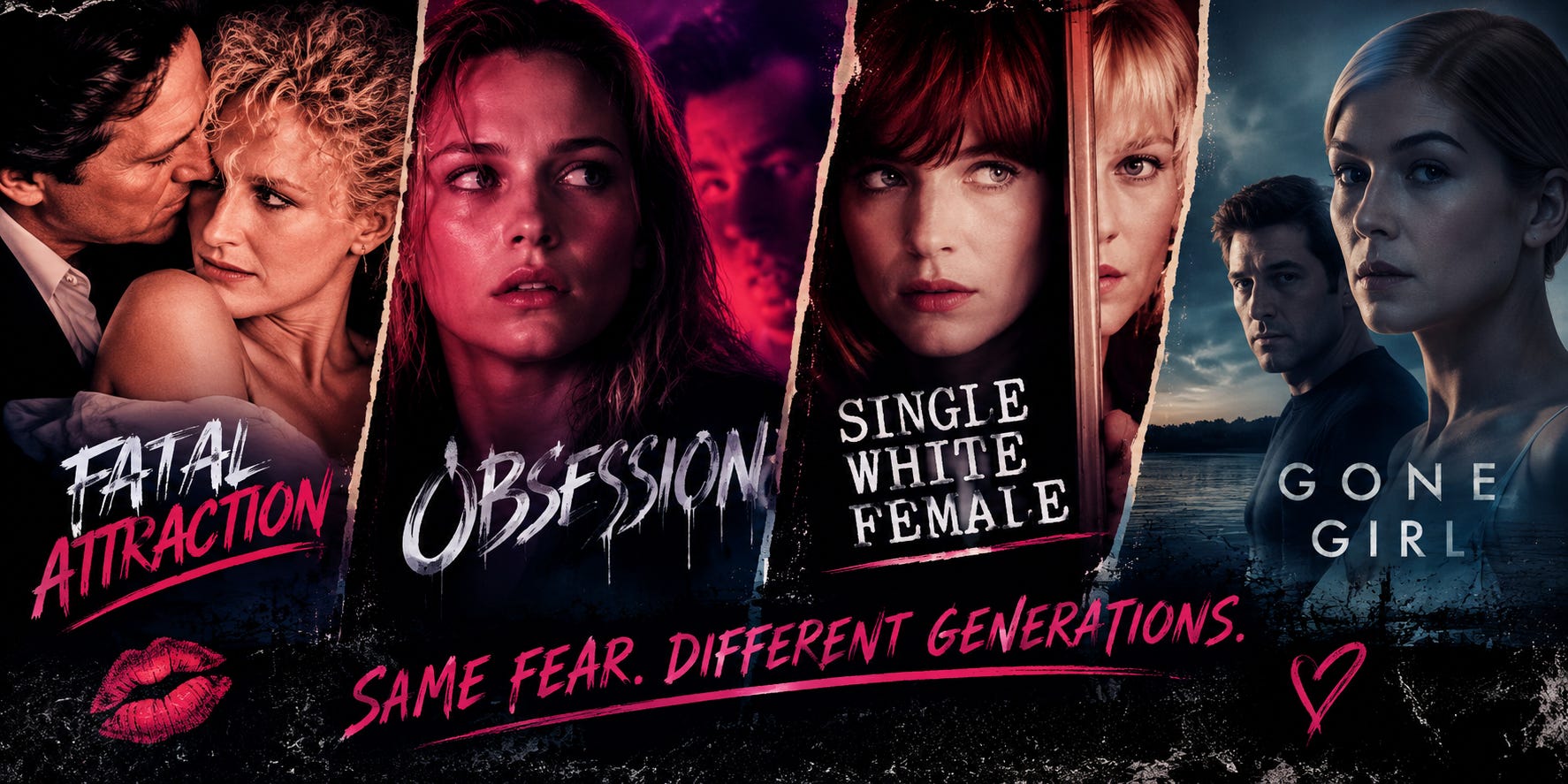
And then, this week while I was thinking about horror movies throughout history, it occured to me that Obsession is to Gen Z what Fatal Attraction was to Baby Boomers.
In Fatal Attraction (1987), the yuppies who came of age during the sexual revolution of the 1960s were coming to terms with the conservative backlash of the Reagan era. AIDS was at its peak, and people of all genders and sexual orientations were dropping dead from sex in real life.
The movie’s central character is a family man with a good job who indulges in an adulterous encounter that almost ruins his life.
The horror comes from the collapse of the boundaries he assumes he can control. To him, it’s just sex, a fling that he feels entitled to given his excellent track record in every other aspect of his life.
What he doesn’t expect is that the woman has her own wants and needs—and is also a stone cold psychopath. Woopsie! Beneath it all is a very obvious societal fear of female sexuality as a metaphor for that which we cannot control.
The double standard is baked in. We see Michael Douglas as the protagonist; a genial, charming, successful everyman. His infidelity is the catalyst, but Glenn Close’s Alex becomes the monster.
She is an ambitious single woman. With her wild blonde hair and unapologetic sexual freedom, she’s already a threat to the society that values family (“family values”) and the 1980s style capitalism that requires a nuclear family driven consumer culture. And that’s before she starts boiling bunnies…
Femme Fatale as Force Majeure
So, while Fatal Attraction asked Baby Boomers, what if one sexual indiscretion ruined your perfect life, Obsession asks Gen Z, what if you could get exactly what you want with no effort, and it ruined your life?
The apps made connection a commodity, but the anxiety remains. What if you could eliminate rejection, uncertainty, and the humiliating possibility that your feelings aren’t reciprocated?
You get the relationship you wanted, but you discover that turning the object of your desire into an NPC (non-playable character) is the biggest nightmare of all.
For Baby Boomers and Gen Z alike, the temptation to treat another person like an object and reduce romantic connection to a reward for your supposedly virtuous main character energy brings about your downfall by way of an ultimately uncontrollable woman.
So that led me to wonder, what are the Generation X and Millenial versions of this horror story? What films in the intervening years between 1987 and 2026 encapsulated those middle generations’ deepest fears? And what are those fears exactly?
Generation X: What if Everyone is Lying?
My first two contenders for generational horror came to me in a flash. They’re not even horror movies, but they speak to the particular fear of growing up the children of Baby Boomers in a society that turned your parents’ dreams of free love, connection, pseudo-spirituality and a quasi-socialist utopia into the crass commercialism, conformity and excess of the 1980s.
We grew up independent, skeptical, and convinced that nothing was more important than our own autonomy. But what if it was all an illusion and we were mere cogs in a vast machine, a rigged system that can’t be gamed, only escaped by any means necessary? What if the only way out is to burn it all down?
The Matrix and Fight Club, both released in 1999, are the ultimate Generation X movies about our deepest fears and wish fulfillment for a meaningful life.
But they’re not exactly horror movies, so here’s another hypothesis: Single White Female (1992), in which the main character has it all figured out until she lets a stranger into her life, and slowly realizes she’s losing everything to a diabolical sociopath who knows her well enough to take everything from her.
The film asks, what if everything you thought you knew about yourself—your independence, your strength, your intelligence and skepticism—could be turned against you when you make the mistake of letting someone in? Your trust and craving for emotional connection are your downfall.
Millennials: Gone Girl
For the generation that grew up being told they could absolutely have it all, only to be confronted with the loss of control on a global scale; mass shootings at school, acts of terrorism and endless wars, and a financial crisis just as they were entering the workforce, the world was an inherently scary place.
But their biggest anxiety isn’t about the outside world. It’s much more intimate. What if the person I think I am isn’t who I really am at all? In a world increasingly mediated by online connections—which are fallible and falsifiable by definition—the question of personal identity and who is anyone really, might be the most frightening of all.
In Gone Girl (2014), the fear isn’t merely that your partner might be lying to you. It’s that the entire relationship might be a performance, and you have no reliable way of knowing who the other person actually is.
Worse, your private relationship becomes public in a way you can’t control, and a parallel narrative exists alongside your private experience that gives other people (an ever-present “audience”) ultimate power over you.
So, what happens when your intimate life becomes a media spectacle? When the person who knows you best knows exactly how to manipulate the story everyone else believes?
Millennials didn’t invent the term “gaslighting,” but they brought the concept out of the mothballs and into the public sphere to the point where no new relationship was safe from the suspicion that the other person could be a complete fabrication.
What if you can’t trust anything but your own senses, and no one believes you because the lie makes a much better story?
Gynophobia
Last week, I played pub trivia with a group of friends and the theme was horror movies and Halloween—because of course it was! One of the categories was “phobias,” and the host named the phobias and we had to define them. It started out easy; agoraphobia, hydrophobia, etc. and got progressively more obscure. One of them was “gynophobia,” the fear of women!
And it occurs to me that all these films could be reduced to that—the fear of crazy bitches. But I think the crazy bitch is just a fun way of characterizing these generational fears. Because in real life, who is more likely to take a one night stand as an invitation to stalk the other person and try to destroy what they can’t have?
Who is more likely to fly into a jealous rage and murder their partner or the person they think is encroaching on their partner, statistically speaking? The answer is obvious, and the subject of almost every women-in-peril movie of the week, slasher flick and serial killer story, real and fictional. They’re 99.9% men.
But that’s what makes stories of crazed women so compelling, across all generations. That’s why we still kind of love Bee (The Babysitter) even after all the murder, mayhem, human sacrifice and devil worship. She’s so cool and beautiful… what’s a little Satanic ritual bloodletting between besties?
Gen X: Black Mirror
There’s often a difference between the horror that defines a generation and the horror that generation ends up foisting on the world when they come of age and start telling stories of their own.
Which brings us back to Generation X (hey, it’s my generation after all!), specifically Charlie Brooker, a wildly intelligent, cynical, irreverent voice of my generation who created one of the most terrifying visions of any generation, the 2011 anthology series Black Mirror.
Now this is Gen X horror of the highest order; technology-fuelled existential nightmares of a near future that always seems just around the corner. What if all our attempts to bring about a techno-utopia only succeed in imprisoning us in an endless nightmare of our own creation?
What if the unelected tech bros (Elon Musk and the Google founders are also Gen X), who have enormous power over every aspect of our daily lives, don’t know what the fuck they’re doing and inadvertently bring about hell on earth?
And we can’t get enough Black Mirror! Seven seasons and still going strong. Charlie Brooker has his finger on the pulse of what truly terrifies us about the future we’re hurtling headlong into.
On that note, let’s get to the lists of my favorite horror films and TV shows of all time!
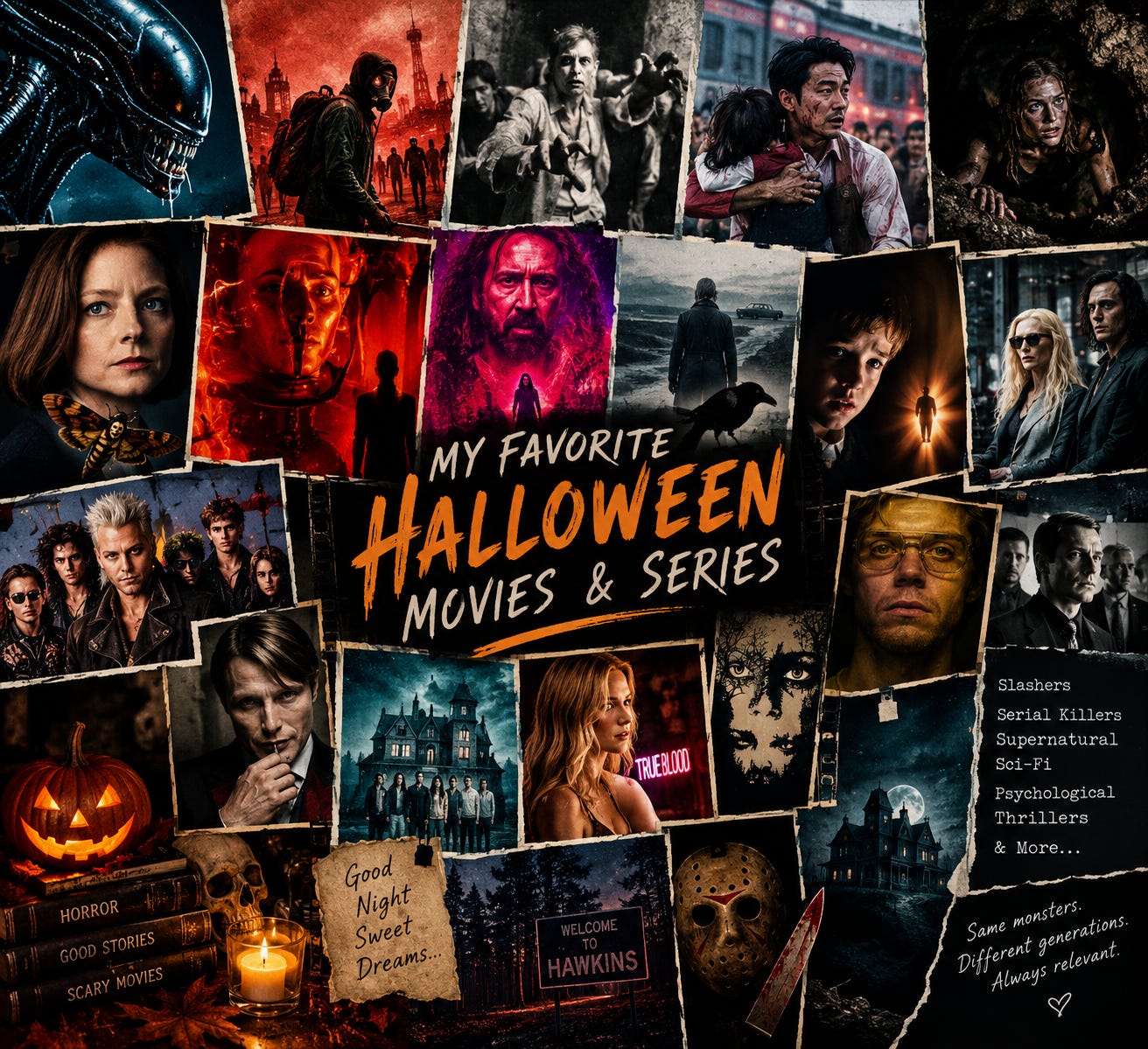
My Favorite Horror Movies of All Time
Alien
28 Days Later
Night of the Living Dead
Train to Busan
The Descent
The Silence of the Lambs
The Cell
Mandy
The Vanishing (original)
The Sixth Sense
Only Lovers Left Alive
My Favorite Horror Series of All Time
Hannibal
Bates Motel
The Haunting of Hill House
True Blood
American Horror Story
The Walking Dead (seasons 1–6)
Dahmer
Mindhunter
What about you, dear readers? Do you love Halloween season? What is the scariest movie or TV show you can’t stop watching? Tell me about it in the comments.