

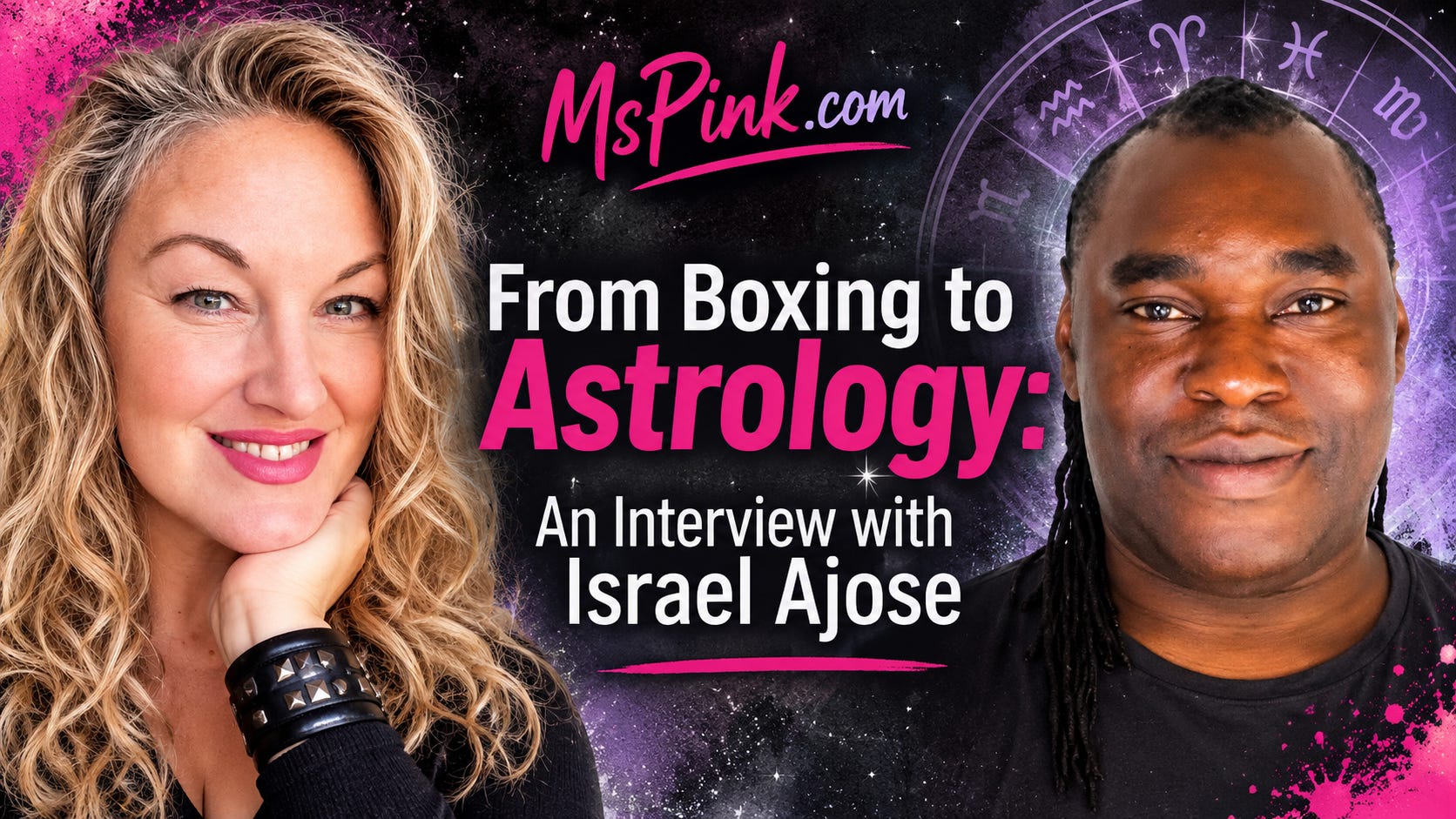
In a recent episode of the Starzology Astrology Podcast, I had the pleasure of interviewing UK-based astrologer Israel Ajose, who has been studying and practising astrology for more than two decades.
Israel’s path to astrology was anything but conventional. His career in boxing was coming to an end just as he entered a profound period of personal transformation following the death of his mother in 1999.
It was during this time that he discovered astrology, and went on to study with the legendary psychological astrologer and author, Liz Greene. Her philosophy of lifelong learning had a profound influence on Israel, and it continues to shape his approach to his practice today.
Over the years, Israel has explored traditional, Hellenistic and medieval astrology, in addition to psychological astrology, developing a practice that brings together a wide range of techniques.
From the Boxing Ring to the Birth Chart
Israel often draws on his experience as a boxer in his work as a consulting astrologer. He even uses boxing analogies when teaching his students, especially when explaining difficult aspects like squares and oppositions.
Boxing taught him the importance of discipline, preparation, anticipation and understanding the dynamics between powerful opposing forces. As it turns out, these concepts also apply to astrological symbolism!
Just as a boxer needs to understand their own strengths and weaknesses, as well as those of their opponent, an astrologer needs to recognise the many forces at work in their own chart before they can understand how they interact with another person’s chart, or with transits to their own chart.
Learning Astrology with Liz Greene
Israel’s formal astrological studies began in the early 2000s when he discovered a course with renowned psychological astrologer Liz Greene.
Her teachings sparked his curiosity, and soon became a calling to the next phase of his life. In addition to psychological astrology, Israel began to explore a wide range of historical techniques, including Hellenistic, medieval, Egyptian, Babylonian and Islamic traditions.
He feels strongly about the importance of studying and preserving older astrological approaches and finding ways to bring them into modern practice. Astrology has an incredibly long and rich history, and there’s still so much to be discovered by looking to the past as well as the future.
Fate, Free Will and Human Psychology
One of the things I admired most about Israel’s approach is how he combines traditional and modern techniques in his practice.
Traditional astrology offers insights into timing, circumstances and potential life events, while psychological astrology gives us a way to explore how we experience and respond to those circumstances.
This naturally led to the topic of fate and free will. Israel believes that while the events and circumstances of life may be beyond our control, we still have agency in how we meet those challenges and grow through them. We control how we react.
Israel frequently repeated his conviction that astrology is about much more than prediction. Although traditional astrology can tend towards the deterministic, he feels there’s value in these ancient techniques. He takes inspiration from the past, and charts a middle ground between the idea that everything is predestined and the belief that we’re fully in control of our fate.
The Prenatal Lunation and UAC
We also talked about Israel’s study of the prenatal lunation, an ancient technique in traditional astrology that is little known in contemporary astrological circles.
Israel presented his research on the prenatal lunation at the United Astrology Conference (UAC) in Chicago in September 2026, exploring its historical significance and potential applications, from interpreting longevity to career prominence.
He explained what the prenatal lunation is, and why it was important to earlier astrologers. He hopes that modern practitioners will discover its usefulness by revisiting some of these largely forgotten techniques.
Historical Cycles
I love to hear about astrologers researching historical cycles and applying them to contemporary events. We are pattern recognizing creatures, and these cycles have been informing our worldview since the very inception of human civilization.
We watched the river rise and fall, and planned our planting and harvesting accordingly. We watched the moon and the stars and charted the events that seemed to recur at regular intervals. We recorded, we interpreted, we predicted, and we revised.
Astrology as a Lifelong Practice
Israel’s interests in mythology and the work of Carl Jung are woven into his approach, particularly the ideas of archetypes and the unconscious. For him, astrology is a convergence between the archetypal world of mythology and the very subjective experience of being human.
Whether you’re interested in traditional astrology, psychological astrology, the history of astrological techniques, or simply curious about how a former boxer found his way into the world of astrology, I think you’ll enjoy our conversation.
Listen to my interview with Israel Ajose on the Starzology Astrology Podcast
Find Israel Online
Website:
https://www.sacredplanets.co.uk/
and
Instagram: @sacredplanets