

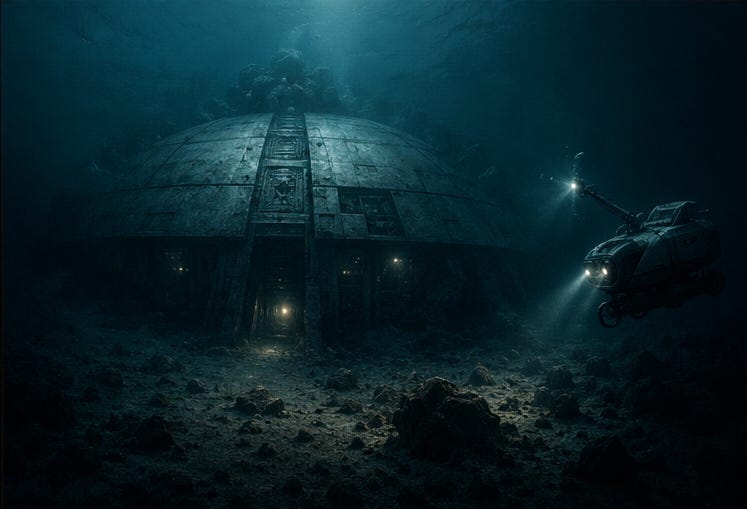
I just finished listening to the audiobook of Lincoln Child’s Deep Storm, so fair warning, I will be spoiling the hell out of it. Stop now if you plan on reading it.
The premise of the book starts out like any other Michael Crichton style sci-fi thriller with a scientist descending to a deep underwater military facility shrouded in secrecy, tasked with unearthing the cause of an epidemic of medical and psychological issues among people working at the facility.
At first he is told they are excavating the lost city of Atlantis, but it turns out it’s a much more recent phenomenon, dating to the year 1398, when one eyewitness’ account recorded the landing of a mysterious craft in the ocean, which caused multiple deaths, leaving only one survivor, largely thought to be crazy.
We eventually discover that it was not some benevolent alien visitors waiting for us to become scientifically aware enough to unearth it and prove ourselves worthy of the quantum leap forward that discovering their technology might bring.
Rather, our planet is the alien version of a toxic waste dump. Earth is in fact a condemned and useless planet that some far more advanced species decided to use to bury their spent weapons, giving no fucks whatsoever about the native species that might stumble across it.
Or do they? The mysterious illnesses might indicate some sort of force field or protective measure that’s been put in place to prevent whatever it is from being discovered.
The book even name-checks the U.S. WIPP, or Waste Isolation Pilot Plant in New Mexico, which is a real life deep geological repository licensed to store transuranic radioactive waste for 10,000 years.
This is Not a Place of Honor
But the question is, who will be around in 10,000 years and how do we communicate with them? How do you make a warning sign for people whose language, culture, technology, system of government, and religious beliefs may be completely alien to ours?
And if that sounds far-fetched, just think of our blind fumblings in the sand, trying to decipher hieroglyphs, sundials, places of worship or burial sites in the ancient world, most of it a lot less than 10,000 years old. When in doubt, we assume, it must have been used for ritual purposes.
In order to tackle such thorny questions, Sandia National Laboratories assembled expert teams to develop possible scenarios for what human society might look like 10,000 years from now, from technological development to economics, and how information might be preserved that would outlast every form of government, religion, or culture on earth.
The Problem of Language
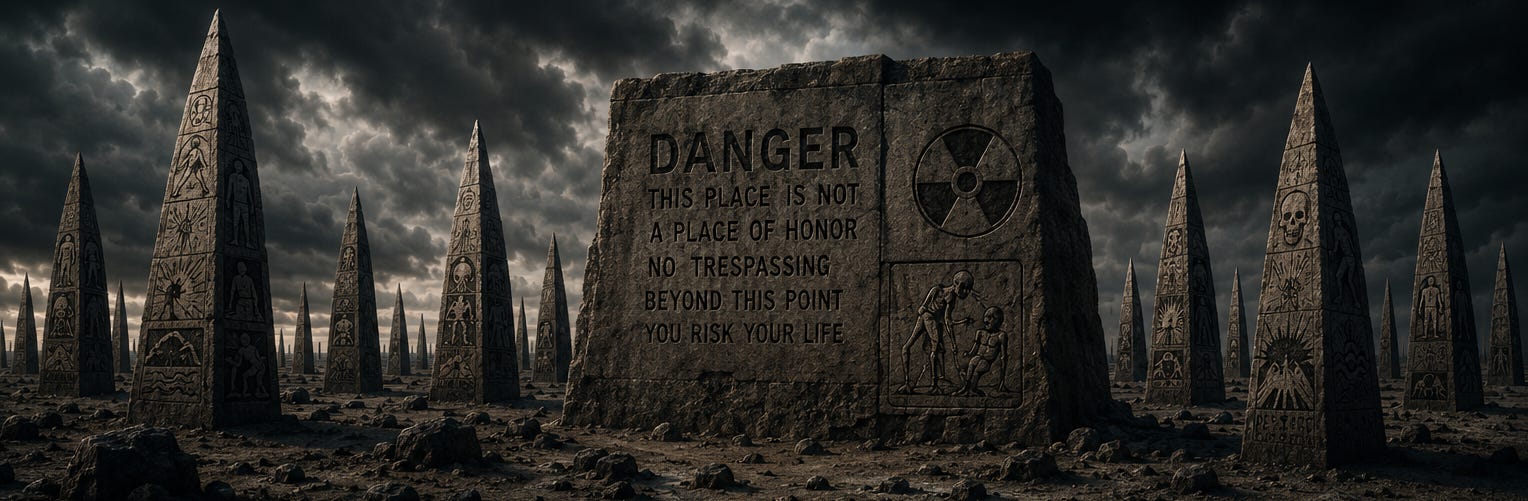
In 1993, Sandia published a report called Expert judgment on markers to deter inadvertent human intrusion into the waste isolation pilot plant. They agreed on several principles:
Clarity is key. The site needs to be unmistakably labeled in a way that communicates something unusual and unnatural is here.
The message must be truthful and informative. No relying on mysterious symbols, mythology or any existing written language, which may not survive. It needs to clearly communicate that people should stay away.
Any single message may fail or be misunderstood. Redundancy is essential. Any format used may decay, deteriorate, be destroyed by natural disasters, or looted if deemed to be precious, like so many ancient artifacts. A system of messages vastly increases the chances of the medium surviving to convey the message.
Combine written language, pictographs, scientific diagrams of varying levels of complexity. Different people from the future may understand different parts of the message and, with any luck, they will come together to decipher it.
Use materials with little monetary value or recyclability. If you construct a massive monolith out of some precious metal or valuable stone, you can expect to have it chipped away and carted off for parts before anyone thinks to read it.
Distribute the information far and wide. The final recommendation was that this should be an international effort, not confined to one nation, government, or culture. A worldwide mission is required to maintain this knowledge if we have any hope of it surviving 10,000 years.
The Problem of Human Nature
Then again, what if it’s not our descendants who find it, but some far future alien archaeologists, exploring the ruins of our planet long after we’ve faded from the scene? Leaving a ticking time bomb under the sands of our future graveyard seems, unfortunately, exactly like something we would do.
But let’s assume for a moment we don’t want to take out those future aliens in a giant nuclear conflagration as our last laugh from beyond the grave.
Then it’s the same kind of question as what we put on the golden record that we sent off with Voyager 1. Will they be able to decipher our pictograms in order to actually play the message? Will they interpret any structure as a religious site or evidence of buried treasure? Is mathematics the universal language or is that just what the nerds want to believe?
In Deep Storm, one of the clues to deciphering the “warning” is a series of mathematical equations that divide by zero, which everyone knows is “forbidden” in math. Forbidden=off limits=stay away, get it? Ugh. Who put the alien nerds in charge?
Beacon or Warning?
Just like in Alien, one of my favorite classic sci fi movies of all time, a beacon can lure passing space travelers to your planet, thinking they’re about to encounter another intelligent species (or the buried treasures of a long dead civilization). But sometimes what sounds like a beacon, is actually a warning to stay away!
Lord knows the ancient Egyptians covered their sarcophagi and pyramids with all the warnings they could imagine to stay the fuck away, lest you be cursed for all eternity because here lies the motherfucking pharaoh… And we all know how that turned out.
The Problem of Curiosity
Even if all the known languages, governments, religions, and societies of today are long forgotten 10,000 years from now, as long as there are humans, the one thing we can count on is they will be curious. And probably greedy.
Finding a way to convey danger whilst also deterring further investigation is a perfect thought experiment for humans who can’t get through a day without diving down every little rabbit hole to discover what’s being hidden from them, who’s lying and who’s telling the truth, what ancient tidbits have we forgotten that might have nostalgic value or poignant meaning to our modern lives?
We are creatures of curiosity if nothing else! I start every day with Connections, Wordle, and Quordle, then end it with a podcast along the lines of “Boring science facts to fall asleep to.” I’m dead serious about that. It’s an entire genre. If you know you know!
That’s probably the thorniest problem of all, overcoming the nature of our own curiosity. How do you craft a warning that short circuits the natural human inclination to say, essentially, “I get it, horrifically burned bodies and deformed babies… but damn it, I just have to know what’s down there!”
A Picture is Worth 10,000 Words
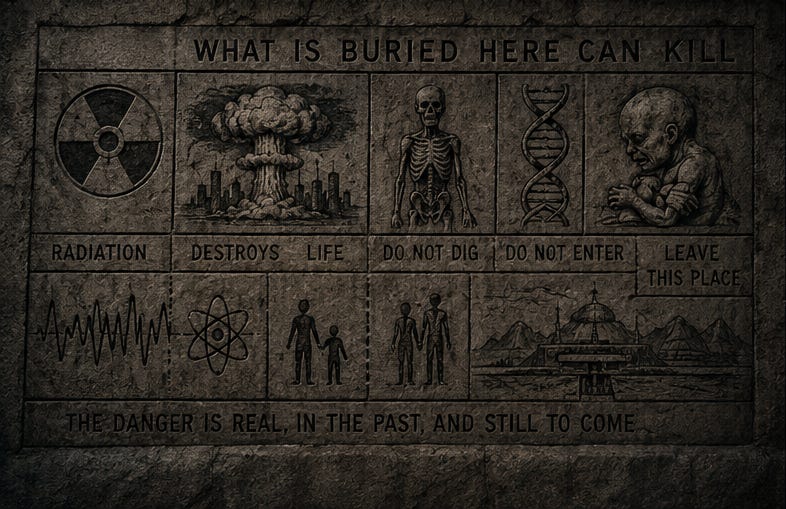
Instead of trying to predict whether a skull and crossbones, now universally understood to mean “danger” (or pirates), will still mean “danger” 10,000 years from now, why not depict the danger in actual pictures?
We may not be able to leave them a hard drive full of images or videos, but hieroglyphics carved in stone have lasted several millennia. What if we etched incredibly graphic images of the effects of nuclear fallout that couldn’t help but be understood by future humans?
We’ve all seen horrific images of radiation-burnt bodies, deformed babies, mushroom clouds flattening entire cities—why not just show that?
(Of course, that doesn’t help if it’s aliens who find it, but hey, we can’t account for every possible outcome.)
When is a Dump Site Not a Dump Site?
In the Final Chapter of Deep Storm, we learn that far from burying the remains of spent weapons in a safe and forgettable backwater, the aliens have most likely left a cache of highly advanced and cosmically dangerous weapons under our ocean for safekeeping so they can return to it later.
Had they intended to merely bury the spent remains of decommissioned weapons, they would have disarmed them, which it turns out they definitely haven’t. Leaving the ominous question, when will they return and what will become of us when they do?
The Problem of Deep Time
Back in high school, my boyfriend and I were huge science fiction fans. I’ll never forget this story he wrote for a creative writing class in our senior year. It haunts me to this day and I’d like to summarize it for you because it’s relevant to this topic.
In the story, explorers arrive on a distant planet, drawn by a faint beacon across the vast reaches of space. They search for its source, but find no evidence of a technologically advanced civilization that could have built a beacon capable of reaching deep space.
All they find are long-buried ruins that may have once been religious sites or communal buildings, but time has worn them away to vague shapes in the sand.
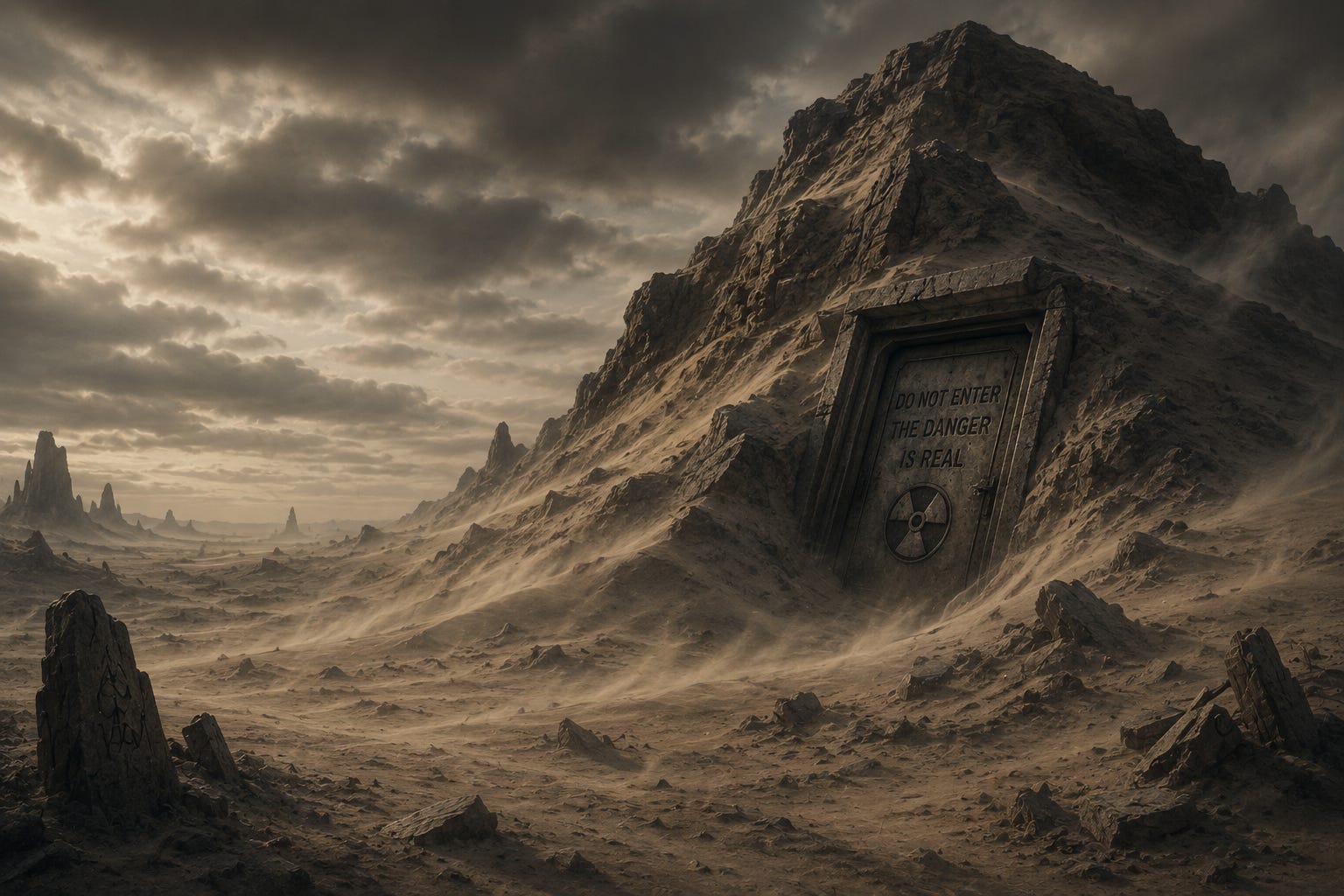
They finally trace the source of the beacon to a mountain in the desert, and a long-buried entrance to a massive structure built into the rock. They’re attacked by ape-like creatures chanting indecipherable gibberish, a word salad of meaningless mantras that defy translation.
They fight their way into the underground facility, and find evidence of a last stand.
A small remnant of the planet’s last survivors had barricaded themselves and eventually starved to death, their remains locked away for eons as their planet descended into chaos, until nothing was left but this final monument buried in the sands above them.
The explorers speculate that they died protecting something down here from the others on the surface, so it must have been of the utmost importance. Maybe a religious relic, tomb, or sacred site. But as they look around, they realize the facility is scientific in nature—highly advanced, in fact—a shocking discovery, considering the primitive state of the rest of the planet.
They locate the source of the beacon on a dusty console, and when they reactivate it, they’re stunned by what they see on the screen. A space-based telescope, floating in the darkness against a blanket of stars, its camera lens long dormant, but pointed at deep space. Its unblinking eye the last witness to the extinction of their civilization.
But what happened to them? And what was this facility to those final few—an apparently educated, idealistic minority—who fought so valiantly to secure it, and defend it with their lives?
The telescope, and the facility that monitored it, are the only evidence that they were once highly intelligent, yet somehow, tragically, they were unable to overcome their baser instincts. For all their hope and curiosity, this fledgling race of space-faring apes destroyed themselves before ever making it out of their solar system.
In the final paragraph, one explorer reads from the screen, tears streaming down his face, fists clenched, horrified and angered at the waste of potential. He turns to the others and says, “They called it Hubble... they were looking at the stars.”
The Problem of the Unknowable
In the end, all our planning and philosophizing may be the mere musings of apes with just enough ingenuity to cast metal stones into the void, or the primitive inhabitants of a backwater planet so far off the beaten path it matters little what any of us do.
But I love that people are thinking about these things. Yes, we’re distracted and addicted to short-terms gains, easily manipulated and so very greedy, but at least someone is out there trying to solve the 10,000 year problems. Some of us are looking at the stars.
WOW! Yes indeed, you are an fantastic writer 💙 we ARE a family of writers...